Showing posts with label Education. Show all posts

Saturday, September 21, 2019

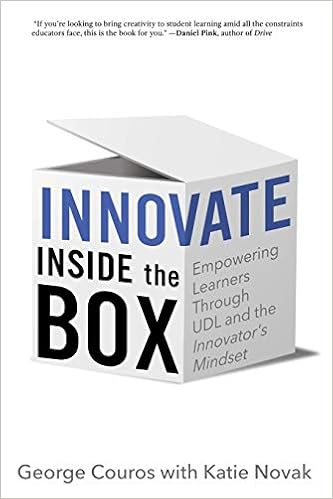
Innovate Inside the Box

Image result for innovate inside the box

In the initial chapters of their new book, Innovate Inside the Box, authors George Couros and Katie Novak tackle the common barriers to progress in education. They argue that despite the many, many constraints educators face, there is room for innovation, improvement, and meeting the needs of ALL students if we maintain an Innovator's Mindset and adopt a Universal Design for Learning.

It's easy to feel defeated by constraints. There are so many that it can feel overwhelming. For example, time is the most obvious one. Not only do teachers feel there is not enough time to teach what they need and want their students to learn, they also feel there is never enough time to work with their colleagues to improve their instruction. The challenge is to remain open to new ways of thinking through these challenges and working with what you have. People have to be willing to try something new and give it a chance before re-evaluating and revising the plan.

Another constraint educators often encounter are the expectations of others. Often based on tradition and not on best practice, people hold on to the way it's always been and resist attempts to change in the name of improvement. Helping resistant people, whether they are fellow educators or parents or even students themselves, understand that school as we know it isn't working as well as it used to is crucial. Today's students have been impacted by multiple traumas in many cases and have different social-emotional needs. In addition, they have different learning styles having come from different developmental experiences and family structures. Finally, the world needs people with different skills. The problems we face require innovative problem-seekers not compliance-trained box checkers.

An additional constraint exists within the standards that are handed down to educators as well the mandatory assessments that are designed to measure student success in meeting those standards. Teachers feel forced into a delivery model of instruction in order to ensure that they've covered their required material with students. Teachers need the time and support to learn a new model of instruction in which students can discover and develop the skills they need for their success both now and in the future. There is room for this within the standards, but so many educators don't take the time to examine the possibilities more closely by asking some of the tough questions: For whom is school working? For whom is it not working? Why? What kind of learning environment, process, and model is best for our students? What do we need to do differently to get there?

As I work with the educators in my school in the never-ending quest to improve our instruction for the benefit of our students, I need to maintain an Innovator's Mindset while navigating constraints. I can continually look for opportunities and possibilities when obstacles arise, create new solutions and ideas for growth, and use other people's success to create our own success.

Monday, January 21, 2019

Image result for storytelling

Because I am a connected educator, I am a better educator. I am active on Twitter for professional use, I listen to educator-produced podcasts, I read professional books or listen to them on Audible, and I read education blogs. These experiences not only enrich my professional practice, they also give me total control over my professional development. I can learn about the topics that are relevant to me, from educators I respect, and at a time that fits my busy life. Often these experiences have an indirect impact on my work in that I might be introduced to a new idea that I continue to research or I may read a post that reinforces the work that I am already doing, helping to build my confidence in the decisions I am making. Other times the impact is immediate.

Recently I was listening to AJ Juliani’s podcast, Scratch Your Itch, on my way to work where I was facilitating a professional development session for teachers. Juliani’s topic for that podcast was the power of storytelling. He said: Our brains pay special attention to stories, engaging more areas of the mind then when we hear or see facts. And when we learn a good story, our brains synthesize the neurochemical oxytocin. This helps us feel others’ emotions and empathize with them.

As I listened to Juliani talk, I was nodding my head as I drove. I have always had emotional responses to stories. They help me visualize, connect, imagine, empathize, and more. Incorporating more storytelling in my interactions with students, staff, and families seemed like a move toward being a more effective communicator. I realized that an opportunity to try this new idea presented itself that very morning at a professional development workshop for my staff.

I opened the session by announcing to the teachers in attendance that I had a story to tell. I described how one day that week I was in the computer lab helping a second grade class get started on their mid-year benchmark tests. I told the group that, as I walked around, making sure that all students were successfully working, I noticed that some students had single sentence with a fill-in- the-blank questions while others had longer, multi-paragraph questions. When I mentioned this to the teacher, she told me she had let the students know to expect tougher questions the more they answered correctly. She told them to just keep trying their best.

The teacher and I happened to be standing behind a young student who often struggled with reading. He receives special education services and has IEP goals for reading. As we stood there, watching his computer screen, a new question popped up...it was a multi-paragraph question. This young student whipped his head around to grin at his teacher. The pride on his face was apparent and contagious. He was truly seeing this testing session as an opportunity to show what he knew and greeted the challenge of a tough question eagerly.

I thanked the teachers in the workshop for their work to make mid-year benchmark testing as positive an experience as possible for their students, for framing testing as an opportunity for students to show how their hard work this year has paid off so far, and to help students set goals for improvement. The focus on my words was intense. More than ever before, I knew I had gotten the teachers’ attention with my story. They were able to catch a glimmer of the message I had been sharing for months about creating a positive testing environment for students and helping them set goals around their performance as a step toward improving results. They were connecting to my message.

I am so grateful that I clicked AJ Juliani’s podcast that morning. His words, like those of so many other amazing and forward thinking educators that I have the opportunity to learn from, are most definitely a large part of the success that I have experienced in my career. As a lifelong learner, I will continue to benefit from being a connected educator.


Tuesday, March 13, 2018

Innovation Ecosystem Design


Just as no two students are exactly the same, no two teachers and no two schools are the same either. Because of varying experiences, people, and communities, leaders need to adjust their strategies for developing an innovation ecosystem to match the needs of the staff, schools, or districts in which they work.

As a new leader in a new district, my first order of business is developing relationships and learning all I could about my setting. What do people value? Where are people coming from? What are our shared goals? Who are our students? What are our challenges? Luckily, our district has a newly created vision statement which outlines the dispositions our stakeholders value most: self-direction, critical thinking, empathy, and perseverance.

As we work to clarify these dispositions so that we have a common understanding of what the dispositions look like at different grade levels and in different subject areas, teachers must feel empowered to develop these traits in our students and themselves - we cannot wait for consensus. These dispositions represent what students need right now. This development will require risk-taking and reflection which can only be encouraged in an environment of trust.

The use of professional learning communities will grow out of a need for collaboration. Our teachers can help each other examine student work and ask the hard questions about what students actually learned despite what we think we taught. This type of analysis will take us to the next level of self-efficacy, the number one teacher trait required to increase student achievement according to Hattie. In addition to PLCs within our school, teachers can develop their own professional learning networks to support their growth within their specific grade levels or subject areas or needs. Having a trusted, online or in-person community to which you can ask challenging questions and with whom you can share and self-reflect is critical for growth as a professional.

As we work on revising our curriculum, we can focus on building opportunities for students to create rather than consume. And I'm not talking about creating a project or an essay that students hand in to the teacher or present to the class at the end of a unit of study. I'm talking about creating every day. To do so will require us to design authentic tasks for authentic audiences. Blogs, blueprints, videos, art, poetry, and models are just a few ways students can create as they learn.

We will need to design professional development opportunities for teachers that is differentiated, personalized, and strength-based. This learning should address the needs of our students and teachers while also staying clearly focused on moving us closer to our vision. Self-reflection and feedback loops must be a critical part of our ecosystem, providing opportunities for growth for individuals as well as our entire system.

Wednesday, February 28, 2018

I'm a Believer!


In chapter one of Katie Martin's new book, Learner Centered Innovation, the author presents a graphic depicting "The Evolving Role of the Educator." Of course this role is multi-faceted and represents a Co-Designer of Powerful Learning, Partner in Learning, Community Developer, and Connector & Activator. To this list of descriptors, I might add: Believer.

Today's educator must be fueled by the belief that we can do better for our students. This belief will motivate us to persevere past the challenges and constraints to innovation that the structure of school often presents. There are some important ways educators can hold on to this belief that have worked for me as I have evolved.

Take Opportunities
When an opportunity for learning presents itself, take hold. For me, an opportunity came up several years into teaching 5th grade in a small elementary school in northwest Connecticut. The Head Teacher retired, and we needed someone to step up. Even though I was worried about the work and responsibility I was taking on in addition to the large job of being the only 5th grade teacher in a K-5 setting, I knew I had something to offer my school community. I took it on with a colleague in a different grade, and we learned a lot and gained valuable experience in our leadership roles. This change led to more opportunities as a Tech Champion, a Lead Teacher in a new district, and now to Director of Curriculum, Instruction, and Innovation in an even different district.

Develop a Personal Learning Network
Reach out to your colleagues close by and also your colleagues far away. Social media has given us access to the expertise and experience that abounds among educators. For me, when I became a Tech Champion for my school, one of the first professional development opportunities that was offered was a trip to FETC. I cannot describe the world that opened up for me as I moved from session to session, listening to and learning from THE experts in the field of technology in education. My students were about to go one-to-one with Chromebooks, and I came back from Orlando ready to start. While at FETC, I joined Twitter at the recommendation of one of the presenters. I quickly found educators to follow and Twitter chats to join. When you find your people, the learning and motivation never end.

Be A Leader
Trust your ideas. Share them with your colleagues near and far. For me, as I stepped into leadership roles, I had the chance to impact the structure of school in new and exciting ways. I could plan professional development, suggest changes to the schedule, introduce new courses for students, examine homework practices, survey staff, students, and parents on school climate and then do something about the results. All of this took courage. I trusted myself to do what was right for students, ALWAYS. I made decisions and recommendations based on that value. More importantly, I believed we could do better for our students in school.

The opportunities that opened up for me, the PLN that I created, and the risks I took as a leader were all fueled by that belief.

Saturday, April 8, 2017

Measuring Innovation


It seems impossible, measuring innovation. And yet we must find a way to show its impact. Proof is powerful when you are trying to convince a community to trust in the unknown, something new that has never been tried at your school or maybe ever. The question becomes: What does that proof look like?

I think we need to be innovative here (pun intended). Before we can decide on which proof we need, we should decide on what we want students to know and be able to do. This is not easy in the complex, connected world in which we now live and for which we need to prepare our students. I like the 4 Cs of 21st Century Learning from P21: collaboration, communication, critical thinking, and creativity. These skills all require innovative thinking in order to be practiced, and they will require educators to be innovative in measuring them. The work is worth it as the 4 Cs are essential to success in an ever-changing economy and society.

For sure, the old A, B, C method will not work. What do these letters mean? What do they tell us about where students are in their development of these critical skills? Standards-based report cards that include various sections such as literacy, mathematics, social skills, and work habits come a little closer as they break larger subject areas down into smaller skills. However, teachers still give students a rating compared to others their age and in their grade level. This only tells parents how close their child is to being like all the others and not how much their child has grown in the given time period since the last report.

What is needed is a new method of capturing growth that includes a student reflection. Given the technology that is available to us now, this new method could take on many shapes and forms. In The Innovator's Mindset, George Couros offers digital portfolios and blogs as a possibility. He makes a strong argument that videos, text, pictures, audio files, Podcasts, slideshows, graphics, and more, all chosen by and reflected upon by the learner gives a true view of learning that is taking place. He also argues that sharing such a portfolio or blog with a larger audience beyond a classroom teacher or even a school provides a learner with authentic feedback. Finally, he suggests that since teachers are also learners, they should be compiling such a portfolio or blog themselves to model the process and gain a better understanding of what they are asking their students to do.

This has inspired me to imagine such a portfolio for myself. Now that I am blogging more, the reflection is happening. How to add work samples to my blog is the next idea to consider for me. Just like looking at student work/creation is key to understanding their learning, looking at my own work will help me connect my ideas with my actions. This is a crucial part of my leadership journey.


Strengths-Based Leadership


Can you imagine asking your staff at the end of the school year, "If you could describe your dream position next year, what would it be?" What would response would you get? What could you learn? How would people feel about being asked? What would you do with the information you learn?

I have a few ideas...

  • You would go a long way to build relationships with your staff just be showing interest in what they think and how they feel;
  • You would be able to personalize PD for your staff by searching out resources that could help them grow in their areas of interest;
  • You would help staff reflect on their practice and lead them to a focus area for the year;
  • You could provide support that would help and encourage them to pursue a goal;
  • You might make staff adjustments to help people do what they want to do;
  • You might develop new courses of study, clubs, or PLCs based on interests.
One thing about which I am sure is this: if you ask staff to share their passions and goals and you work to help them engage in those passions and reach those goals, you will have a staff that is invested in their school and willing to go above and beyond the call of duty.


Teachers Must Also Be Learners


In the same way that George Couros asks us to imagine inquiry based learning for staff as well as students, I'm imagining substituting "schools" for "classrooms" in the center of Sylvia Duckworth's visual of 8 Things to Look for in Today's Classroom.

If today's schools were learner-focused and teachers were learners just as much as students, then we might see teacher voice and choice in terms of topics they are exploring and would like to share with colleagues for feedback. Also, we would see time for reflection and innovation built into faculty meetings and professional development days. We would see teachers being encouraged to ask questions, challenge ideas, and identify problems to be solved in school. Finally, we would see teachers welcomed as part of the evaluation process in assessing themselves based on goals they set. In addition, teachers would be connected to a professional learning network both in their local community and also globally.

This mindshift for teachers to see themselves as learners would require support, openness, and a risk-taking environment which can only be fostered and modeled by the school's leaders.


Tuesday, March 14, 2017

Building Relationships


As George Couros says in The Innovator's Mindset, "If we want meaningful change, we have to make a connection to the heart before we can make a connection to the mind."

Connecting to a person's heart requires a strong, positive relationship. Relationships are intentional, they take effort to build, but that doesn't mean they can be faked. A leader must genuinely care about the people he or she leads to have the most success in building relationships. There is no shortcut here. All day every day leaders need to show they care by listening, asking about people's lives both in and out of school, remembering details that are important to people, celebrating success, offering support, and making time for people.

Just as important, leaders need to model the relationship-building actions they'd like their staff to use. Leaders need to be all in for whatever the school needs, willing to do any job because all jobs are important, and interacting with all students because they are ALL our students. Leaders need to hold expectations high for staff and even higher for themselves, share their goals and passions, take risks, admit mistakes, model growth, be human, and also be their best selves.

When staff can connect to their leader on a human level and they know their leader genuinely cares about them as people, they will be ready to learn from and with that leader in the name of what's best for kids.

School vs. Learning


School is about knowing a finite amount of core knowledge in an organized way that makes it easy to replicate in multiple settings with a variety of populations.

Learning is about practicing an ever-growing set of skills and dispositions that allow a person to lead his or her own learning about topics of interest and personal use. This process is difficult to replicate across settings but guides students to look at their world critically, find problems to be solved, and know where to start to find those solutions.

Although school might be easier to control and measure, it becomes obsolete as an organization when the students that enter are already savvy, self-directed learners who have had access to information since they were old enough to hold a device. These students know that the teacher is not the only source of information as they already have experience in pursuing their own passions, finding out what they need to know when they need to know it. They are connected to people around the world who share options for life paths and missions to pursue.

School needs to catch up to a changed world and acknowledge an unknown future to be sure we are preparing students who learn to succeed.


What If We Were ALL Learners?


In The Innovator's Mindset, George Couros proposed several "What if" questions to help us reflect on a new vision for schools. One of the questions that resonated with me in a particularly strong way was, "What if schools operated as if we should all be 'learners,' as opposed to students being the only learners?"

I see why teachers would be uncomfortable being categorized as learners. After all, teachers did not go through years of school, earning multiple degrees, to be put back in the place of learners. They see themselves as professionals. How disconcerting to think their expertise is being called into question. So if we are going to reframe teachers as learners, we need to be clear about what they are supposed to know as well as what they are supposed to learn.

Teachers need to know the standards they are to teach and how to translate them into student-friendly language; who their students are as people and learners both in and out of the classroom including their strengths and weaknesses, their hobbies and experiences; which resources are available to them and their students for learning, creating, and sharing; how to teach students to ask questions and find problems to solve...the list goes on.

What teachers need to be open to learn is how people learn! With a constantly changing population of students who bring new interests and experiences with them to school, new technology and other resources being developed every day, access to information and communication at a scale and rate that grows exponentially each week, and scientists studying and revealing new information about the human brain and how it learns...the learning must continue for teachers. It can continue as long as teachers have an innovator's mindset and remain ready to learn and connected to the sources of information available to them.

Sunday, March 5, 2017

"Learning is creation, not consumption." #IMMOOC Blog Post 2


In Part I of The Innovator's Mindset, one idea that really gave me pause for reflection was the quote from The Center for Accelerated Learning on pg. 55, "Learning is creation, not consumption." It made me think of a sixth question to add to the list of Critical Questions for the Innovative Educator:

What evidence of learning do we see in this student's creation?

For several years I have believed in the power of looking at student work in shifting a teacher's focus from what they are doing to what their students are doing. This shift is important because I have known many teachers who think only about what and how they are teaching, how their day is going, how hard they are working, how busy and stressed they are, how frustrating or amazing their students  can be. I have argued that looking at student work is what is needed to deepen PLC conversations and refocus teacher energy on the student experience. After all, it's the student learning that is the purpose of our work.

Now I feel the need to revise my mantra from "looking at student work" to "looking at student creations." In a creation, a teacher would see not just facts or algorithms regurgitated onto a page, instead she would see synthesis, prioritization, and communication about a topic or concept. This tells us so much more about a student's strengths and weaknesses, his "soft skills," his depth of understanding, and his ability to share it with others.

The painting shown above was created by my daughter for her high school art class. I am not an artist myself, but I can appreciate the skill, focus, persistence, planning, and time management that went into this creation, and I bet her teacher can see it too.

Tuesday, February 21, 2017

I #loveteaching

     I #loveteaching because of the impact I get to make on our future. I believe all children come to kindergarten with enthusiasm, joy, and wonder about the world, even students whose traumatic lives make it difficult to express it. Teachers have the opportunity to further foster those traits in their students each and every day of each and every school year. Students who learn from these teachers will be creative, kind, and positive learners who will grow up to create the kind of world in which we all want to live. To be clear, when I say teachers, I mean to include all educators-principals, counselors, specialists, interventionists, para-educators-ALL educators. There are so few professions that get to say they play such an important role in the lives of others as well as the future of our society and the world.
     Don't get me wrong. What I'm talking about here is not easy. Teachers must juggle the restraints, demands, and requirements of their jobs with creating a culture of safety, acceptance, and challenge in their classrooms and schools. This can sometimes feel like an impossible task. However this is where every teacher can make a choice to persevere in the work they know is so critical despite the demands of their jobs. The key word here is choice.
     Teachers can choose to build relationships, to work hard, to respect all families, to improve their teaching, to challenge students where they are, to recognize all staff as playing essential roles, to enjoy teaching, and to be all in for education. I know I've made these choices, and it has paid off in the learning I see every day.

Wednesday, November 30, 2016

Kindness Through Gratitude

Like so many schools, ours is working toward improving our climate. Our Safe School Climate Team is made up of several very caring and dedicated teachers, mental health specialists, paraeducators, and parents. We meet several times each year to discuss ways we can generate positive school climate. We research, go to workshops, read, and go to our colleagues and PLNs for ideas.

We were using data from our district-wide safe school climate survey to identify areas of weakness until the survey results no longer gave us useful information. Last year, in a search for direction, we created our own school-specific survey written in student-friendly language. What we learned, we really knew all along-our students need practice in tolerance, inclusion, and participation in conversations. These are the mindsets and skills that many K-4 students might need to practice.

At first we focused on teaching and encouraging students to join games and conversations. Now we've turned our attention in a new direction-gratitude. We realized that it was not as effective to encourage the few more timid students to take risks as it was to encourage the many more confident students to be kind. The problem is the "be kind" message, although simple and powerful, was vague as well as overused in our community. Our team felt a more active way to promote kindness was to teach students how to be grateful, for research shows that people who practice gratitude are happier, kinder, and more satisfied. This made sense to our team because we, in our individual ways, felt the power that consciously practicing gratitude had in our personal lives.

So we are embarking on a new mission-to teach students how to recognize the people, places, things, and ideas in their lives for which they should be grateful and that taking time each day to acknowledge their good fortune will motivate them to spread kindness to others.

Tuesday, November 15, 2016

Leading is Serving

Some who read the title of this blog will understand it immediately. Some may need clarification. Some will think I've written an oxymoron.

It might be helpful to know that I am an educator. Currently I serve as a Lead Teacher in a K-4 school  in Connecticut. Previously I was a classroom teacher for fifteen years at the elementary and middle school levels. In all of these positions I led students and staff by serving them.

I find resources for teachers who want to try new strategies with their students. I process problems with children to help them learn from their mistakes and restore their relationships with their friends. I meet with parents to plan family activities that get people involved in our school. I supervise in the cafeteria and at dismissal. I say hello and smile at everyone I pass in the hall. I stop and listen to anyone who wants to let me know when there is an issue or when a student has met a goal or when a parent is ill. I believe every interaction is an opportunity to build a relationship.

Of course a leader develops a vision for his school. In creating this vision, the leader is serving his people by imagining a lofty goal that he expects the school to reach.

However, in order to guide and support the school in achieving the vision, the leader must serve his people through strong relationship-building and hands-on involvement in the day-to-day activities of the school. This is leading through serving.