Showing posts with label Creation. Show all posts

Saturday, September 21, 2019

Innovate Inside the Box

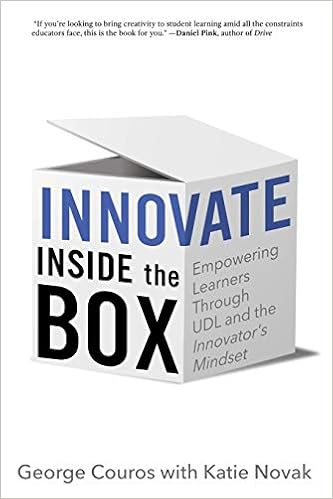
Image result for innovate inside the box

In the initial chapters of their new book, Innovate Inside the Box, authors George Couros and Katie Novak tackle the common barriers to progress in education. They argue that despite the many, many constraints educators face, there is room for innovation, improvement, and meeting the needs of ALL students if we maintain an Innovator's Mindset and adopt a Universal Design for Learning.

It's easy to feel defeated by constraints. There are so many that it can feel overwhelming. For example, time is the most obvious one. Not only do teachers feel there is not enough time to teach what they need and want their students to learn, they also feel there is never enough time to work with their colleagues to improve their instruction. The challenge is to remain open to new ways of thinking through these challenges and working with what you have. People have to be willing to try something new and give it a chance before re-evaluating and revising the plan.

Another constraint educators often encounter are the expectations of others. Often based on tradition and not on best practice, people hold on to the way it's always been and resist attempts to change in the name of improvement. Helping resistant people, whether they are fellow educators or parents or even students themselves, understand that school as we know it isn't working as well as it used to is crucial. Today's students have been impacted by multiple traumas in many cases and have different social-emotional needs. In addition, they have different learning styles having come from different developmental experiences and family structures. Finally, the world needs people with different skills. The problems we face require innovative problem-seekers not compliance-trained box checkers.

An additional constraint exists within the standards that are handed down to educators as well the mandatory assessments that are designed to measure student success in meeting those standards. Teachers feel forced into a delivery model of instruction in order to ensure that they've covered their required material with students. Teachers need the time and support to learn a new model of instruction in which students can discover and develop the skills they need for their success both now and in the future. There is room for this within the standards, but so many educators don't take the time to examine the possibilities more closely by asking some of the tough questions: For whom is school working? For whom is it not working? Why? What kind of learning environment, process, and model is best for our students? What do we need to do differently to get there?

As I work with the educators in my school in the never-ending quest to improve our instruction for the benefit of our students, I need to maintain an Innovator's Mindset while navigating constraints. I can continually look for opportunities and possibilities when obstacles arise, create new solutions and ideas for growth, and use other people's success to create our own success.

Tuesday, March 13, 2018

Innovation Ecosystem Design


Just as no two students are exactly the same, no two teachers and no two schools are the same either. Because of varying experiences, people, and communities, leaders need to adjust their strategies for developing an innovation ecosystem to match the needs of the staff, schools, or districts in which they work.

As a new leader in a new district, my first order of business is developing relationships and learning all I could about my setting. What do people value? Where are people coming from? What are our shared goals? Who are our students? What are our challenges? Luckily, our district has a newly created vision statement which outlines the dispositions our stakeholders value most: self-direction, critical thinking, empathy, and perseverance.

As we work to clarify these dispositions so that we have a common understanding of what the dispositions look like at different grade levels and in different subject areas, teachers must feel empowered to develop these traits in our students and themselves - we cannot wait for consensus. These dispositions represent what students need right now. This development will require risk-taking and reflection which can only be encouraged in an environment of trust.

The use of professional learning communities will grow out of a need for collaboration. Our teachers can help each other examine student work and ask the hard questions about what students actually learned despite what we think we taught. This type of analysis will take us to the next level of self-efficacy, the number one teacher trait required to increase student achievement according to Hattie. In addition to PLCs within our school, teachers can develop their own professional learning networks to support their growth within their specific grade levels or subject areas or needs. Having a trusted, online or in-person community to which you can ask challenging questions and with whom you can share and self-reflect is critical for growth as a professional.

As we work on revising our curriculum, we can focus on building opportunities for students to create rather than consume. And I'm not talking about creating a project or an essay that students hand in to the teacher or present to the class at the end of a unit of study. I'm talking about creating every day. To do so will require us to design authentic tasks for authentic audiences. Blogs, blueprints, videos, art, poetry, and models are just a few ways students can create as they learn.

We will need to design professional development opportunities for teachers that is differentiated, personalized, and strength-based. This learning should address the needs of our students and teachers while also staying clearly focused on moving us closer to our vision. Self-reflection and feedback loops must be a critical part of our ecosystem, providing opportunities for growth for individuals as well as our entire system.

Saturday, April 8, 2017

Measuring Innovation


It seems impossible, measuring innovation. And yet we must find a way to show its impact. Proof is powerful when you are trying to convince a community to trust in the unknown, something new that has never been tried at your school or maybe ever. The question becomes: What does that proof look like?

I think we need to be innovative here (pun intended). Before we can decide on which proof we need, we should decide on what we want students to know and be able to do. This is not easy in the complex, connected world in which we now live and for which we need to prepare our students. I like the 4 Cs of 21st Century Learning from P21: collaboration, communication, critical thinking, and creativity. These skills all require innovative thinking in order to be practiced, and they will require educators to be innovative in measuring them. The work is worth it as the 4 Cs are essential to success in an ever-changing economy and society.

For sure, the old A, B, C method will not work. What do these letters mean? What do they tell us about where students are in their development of these critical skills? Standards-based report cards that include various sections such as literacy, mathematics, social skills, and work habits come a little closer as they break larger subject areas down into smaller skills. However, teachers still give students a rating compared to others their age and in their grade level. This only tells parents how close their child is to being like all the others and not how much their child has grown in the given time period since the last report.

What is needed is a new method of capturing growth that includes a student reflection. Given the technology that is available to us now, this new method could take on many shapes and forms. In The Innovator's Mindset, George Couros offers digital portfolios and blogs as a possibility. He makes a strong argument that videos, text, pictures, audio files, Podcasts, slideshows, graphics, and more, all chosen by and reflected upon by the learner gives a true view of learning that is taking place. He also argues that sharing such a portfolio or blog with a larger audience beyond a classroom teacher or even a school provides a learner with authentic feedback. Finally, he suggests that since teachers are also learners, they should be compiling such a portfolio or blog themselves to model the process and gain a better understanding of what they are asking their students to do.

This has inspired me to imagine such a portfolio for myself. Now that I am blogging more, the reflection is happening. How to add work samples to my blog is the next idea to consider for me. Just like looking at student work/creation is key to understanding their learning, looking at my own work will help me connect my ideas with my actions. This is a crucial part of my leadership journey.


Sunday, March 5, 2017

"Learning is creation, not consumption." #IMMOOC Blog Post 2


In Part I of The Innovator's Mindset, one idea that really gave me pause for reflection was the quote from The Center for Accelerated Learning on pg. 55, "Learning is creation, not consumption." It made me think of a sixth question to add to the list of Critical Questions for the Innovative Educator:

What evidence of learning do we see in this student's creation?

For several years I have believed in the power of looking at student work in shifting a teacher's focus from what they are doing to what their students are doing. This shift is important because I have known many teachers who think only about what and how they are teaching, how their day is going, how hard they are working, how busy and stressed they are, how frustrating or amazing their students  can be. I have argued that looking at student work is what is needed to deepen PLC conversations and refocus teacher energy on the student experience. After all, it's the student learning that is the purpose of our work.

Now I feel the need to revise my mantra from "looking at student work" to "looking at student creations." In a creation, a teacher would see not just facts or algorithms regurgitated onto a page, instead she would see synthesis, prioritization, and communication about a topic or concept. This tells us so much more about a student's strengths and weaknesses, his "soft skills," his depth of understanding, and his ability to share it with others.

The painting shown above was created by my daughter for her high school art class. I am not an artist myself, but I can appreciate the skill, focus, persistence, planning, and time management that went into this creation, and I bet her teacher can see it too.